

Spray a 1:1 mix of white vinegar and water on the stains, leave it for 10–15 minutes, scrub with a soft brush, rinse and wipe dry. For thick white crust, follow up with a baking soda paste. Never use vinegar, lemon or acid cleaners on marble, Kota stone or other natural stone; use a pH-neutral stone cleaner instead.
That's how to remove hard water stains from tiles in most bathrooms. The rest of this guide helps you match the method to your tile and your stain, so you clean faster and don't damage anything.
What are those white stains on your bathroom tiles?
Hard water stains are minerals left behind when water dries. Water in many homes carries dissolved calcium, magnesium and salts. When a splash evaporates, the water goes and the minerals stay, building a chalky white layer called limescale.
Before you scrub, check what you are actually looking at:
What you see | What it usually is | What removes it |
White, chalky, rough to touch | Limescale (hard water) | Mild acid: vinegar or lemon |
Grey, greasy film that smears | Soap scum mixed with minerals | Dish soap first, then vinegar |
Orange or brown patches near taps | Iron in the water | Lemon or a rust-safe tile cleaner |
White powder pushing out of grout | Efflorescence (salts from inside the wall) | Dry brush; fix the seepage source |
Black spots in grout corners | Mould, not hard water | Hydrogen peroxide or a mould cleaner |
Why Delhi NCR bathrooms get hard water stains so fast
If your tiles turn white again a week after cleaning, your water is the reason. The Central Ground Water Board's yearbook for 2021-22 found that groundwater in most of Delhi is brackish, and that outside parts of east Delhi and a few western pockets, its salt content is very high (Daily Pioneer). The same report recorded high iron in areas such as Rohini and Burari, which explains orange stains near taps.
Homes that use borewell or tanker water, or mix them with municipal supply, see the fastest build-up. That's why a weekly 5-minute routine (see below) matters more in NCR than in most cities.
Check your tile type first
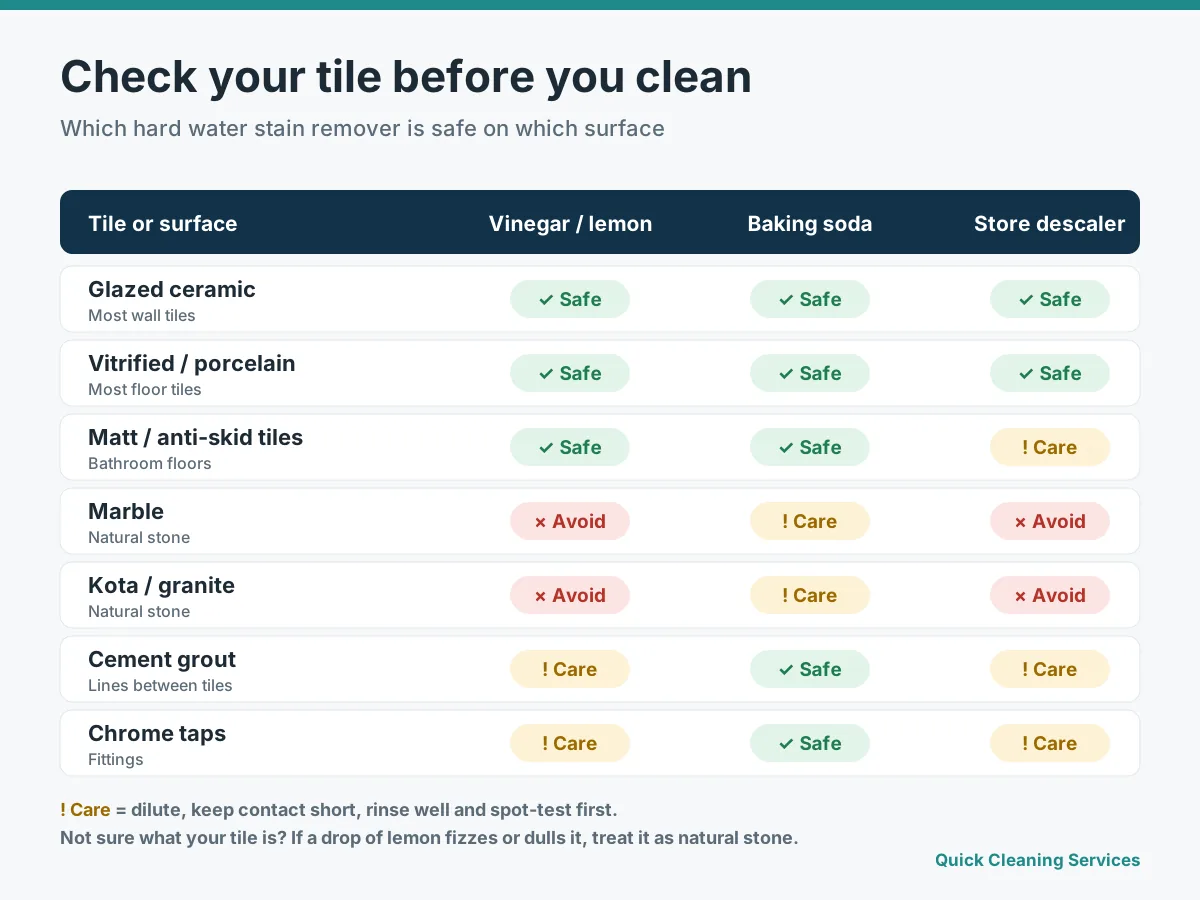
Before you remove hard water stains on tile, check what the tile is made of. The wrong cleaner can etch or dull it in seconds. Find your tilein this table before you start.
Tile or surface | Vinegar / lemon | Baking soda | Commercial descaler | Best approach |
Glazed ceramic (most wall tiles) | Safe | Safe | Safe, follow label | Vinegar spray, then paste |
Vitrified / porcelain | Safe | Safe | Safe, follow label | Vinegar spray, then paste |
Matt or anti-skid floor tiles | Safe | Safe | Spot-test first | Paste + stiff nylon brush |
Marble | Avoid | Gentle only | Avoid acid-based | pH-neutral stone cleaner |
Kota stone / granite / other natural stone | Avoid | Gentle only | Avoid acid-based | pH-neutral cleaner; professional polish for etching |
Cement-based grout | Diluted, short contact | Safe | Brief contact only | Paste + toothbrush, then seal |
Chrome taps and fittings | Diluted, short contact | Safe | Check fitting label | Vinegar cloth wrap, max 30 min |
Not sure what your tile is? Put one drop of lemon juice on a hidden corner. If it fizzes or leaves a dull mark after a minute, treat it as natural stone.
What you'll need
- White vinegar (the kitchen kind is fine)
- Baking soda
- Spray bottle
- Soft brush or non-scratch sponge, and an old toothbrush for grout
- Microfibre cloth
- Rubber gloves, and an open window or exhaust fan on
Methods, from mildest to strongest
Start at the top and only move down if the stain stays. Most bathrooms never need step 5.
Stain level | Looks like | Start with |
Light | Fresh water spots, faint haze | Method 1 |
Medium | Visible white layer, slightly rough | Methods 1 + 2 |
Heavy | Thick crust, months of build-up | Method 2, repeated, then method 5 |
Stone surfaces | Any level | Method 4 only |
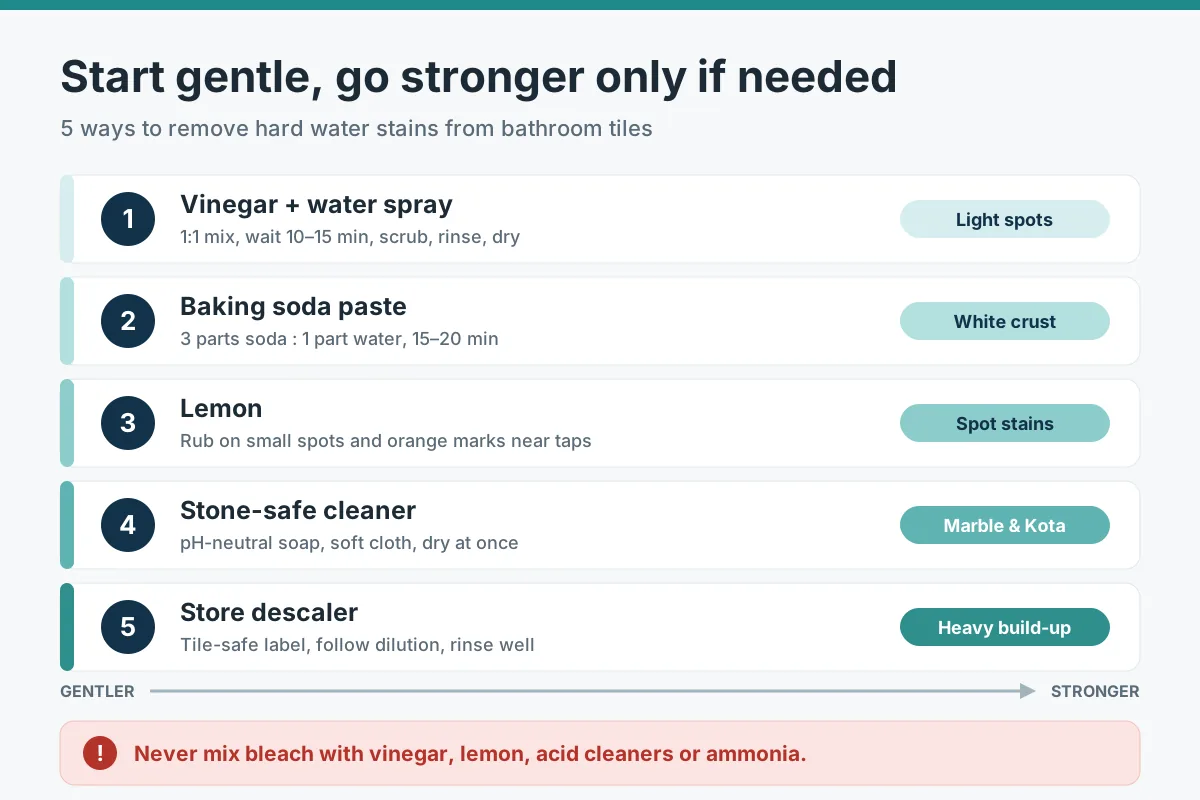
Method 1: Vinegar and water spray
- Mix equal parts white vinegar and water in a spray bottle.
- Spray the stained tiles until they are fully wet.
- Wait 10–15 minutes. Spray again if it starts to dry.
- Scrub in small circles with a soft brush.
- Rinse with clean water and wipe completely dry.
For wall tiles, spray from the bottom up and wipe from the top down, so drips don't leave fresh streaks.
Method 2: Baking soda paste for thick crust
- Mix 3 parts baking soda with 1 part water into a thick paste.
- Spread it over the crusty areas after the vinegar spray.
- Leave 15–20 minutes, then scrub with a nylon brush.
- Rinse well. Repeat on stubborn spots.
Baking soda is a mild abrasive, so it lifts crust without scratching glazed tiles.
Method 3: Lemon for small spots and orange stains
Rub half a lemon directly on the spot, leave 5 minutes and wipe. It works well on iron-orange marks near taps and on chrome. Rinse afterwards, as lemon left to dry can leave its own film.
Method 4: Stone-safe method for marble and Kota
- Wipe the surface with warm water and a few drops of pH-neutral liquid soap or a stone cleaner.
- Use a soft cloth, never a scrubber.
- For marks that won't lift, make a thin baking soda and water paste, apply gently, and rinse within 5 minutes.
- Dry immediately.
If the stone looks dull or rough after cleaning, it is etched, not stained. Etching needs professional polishing.
Method 5: Commercial descaler (last resort)
For heavy build-up on ceramic or vitrified tiles, a bathroom descaler or limescale remover from the market can work faster. Choose one labelled safe for tiles, follow the dilution on the bottle, keep contact time short, and rinse thoroughly. Avoid using undiluted hydrochloric acid (muriatic acid): it can eat into grout and fittings and gives off harmful fumes.
Never mix bleach with vinegar, lemon, acid cleaners or ammonia. These combinations release toxic gases. Use one product at a time, and rinse fully before switching.
How to clean bathroom floor tiles, wall tiles and grout
Bathroom floor tiles: Toilet floor tiles and the area under the shower collect the heaviest crust. Sweep first, then use methods 1 and 2 with a long-handled stiff nylon brush. Dry the floor with a mop afterwards; standing water is what creates the next stain.
Wall tiles: Work in one-metre sections so the vinegar doesn't dry before you scrub. Pay extra attention to the band at shower height and the area behind taps.
Grout: Grout is porous and absorbs minerals. Apply baking soda paste with a toothbrush, spray lightly with vinegar so it fizzes, scrub along the lines and rinse. Don't leave acid on grout for long. Once clean and dry, a grout sealer slows down future staining.
Mistakes that damage tiles
- Using steel wool or metal scrubbers, which scratch the glaze and make tiles stain faster.
- Using vinegar, lemon or acid on marble, Kota or granite.
- Mixing cleaning products, especially bleach with anything acidic.
- Leaving descaler on for "extra strength" beyond the label time.
- Letting tiles air-dry after cleaning, which lays down a fresh layer of minerals.
How to stop hard water stains coming back
The easiest way to clean bathroom tiles and keep stains away is a 5-minute weekly routine:
- After each bath: squeegee or wipe the shower wall and floor dry.
- Once a week: spray the vinegar mix on wet-zone tiles and taps, wait 5 minutes, wipe and dry.
- Once a month: scrub grout lines with baking soda paste.
- Fix drips: a leaking tap or jet spray creates a permanent wet patch.
- Consider a water softener or shower filter if your home uses borewell or tanker water.
When to call a professional
DIY works for most stains. It stops working when:
- The crust has built up for a year or more and doesn't move after two rounds.
- Marble, Kota or granite looks dull or rough (etched) rather than stained.
- Grout is crumbling, discoloured deep down or growing mould.
- You are moving in or out and need the whole bathroom restored at once.
Professional teams use machine scrubbers and tile-specific chemicals that clean faster and more evenly than hand scrubbing. If you're in Delhi NCR, our home deep cleaning service can handle the whole bathroom for you.
FAQs
Does vinegar damage bathroom tiles?
Not glazed ceramic or vitrified tiles, when diluted and rinsed off. It does damage marble and other natural stone, and long contact can weaken cement grout.
Can I use Harpic or a toilet cleaner on bathroom tiles?
Some bathroom cleaners are made for tiles; toilet-bowl cleaners are often stronger acids made for porcelain bowls. Check the label says it is safe for tiles, dilute as directed, and never use it on stone.
How long do hard water stains take to remove?
Light spots go in one 15-minute round. Months of crust usually take two or three rounds of vinegar and baking soda paste.
Why do the stains come back within days?
Because the water itself is mineral-heavy. Stains return when tiles air-dry. Drying after use and a weekly vinegar wipe stop most re-staining.
Is hard water staining harmful to health?
The stains themselves are mostly a cleaning problem, not a health one. But damp, scaled grout can hold mould, which is worth cleaning out regularly.